FOR-GHP
FOR-GHP Fellowship
Outbreak Readiness for Global Health Protection
About the FOR-GHP Fellowship Programme
The "Fellowship in Outbreak Readiness for Global Health Protection" (FOR-GHP) is funded by the German Federal Ministry of Health within the framework of the Global Health Protection Programme (GHPP). FOR-GHP uses a multiplier approach to enhance health emergency preparedness, response and resilience among public health structures across sub-Saharan Africa.
Natural and intentional disease outbreaks pose major risks. Effective outbreak management and fulfilling International Health Regulations require a skilled, well-trained workforce. Innovative, sustainable training initiatives are needed to strengthen competency and capacity.
FOR-GHP leverages a seasoned consortium (Africa Field Epidemiology Network, Bernhard Nocht Institute for Tropical Medicine, Robert Koch Institute, Swiss TPH) and validated blended learning to empower local experts who act as multipliers for regional impact.
The objectives are to:
- To strengthen fellows’ competencies in outbreak management, with a special focus on One Health and global health security, using digital and in-person learning methods, including simulation exercises
- To train experts as effective facilitators, multipliers and leaders in their home institutions and countries (including context-specific teaching case studies) to maximise local impact
- To facilitate implementation of capacity strengthening measures within regional networks to promote knowledge exchange, collaboration, and coordinated outbreak response
- To foster long-term sustainability and impact through growing and nurturing an active alumni network to support continuous collaboration, mentorship, and peer learning
FOR-GHP Consortium




The FOR-GHP training programme
The objectives of the programme are:
- To strengthen fellows’ competencies in outbreak management, with a special focus on One Health and global health security, using digital and in-person learning methods, including simulation exercises
- To train experts as effective facilitators, multipliers and leaders in their home institutions and countries (including context-specific teaching case studies) to maximise local impact
- To facilitate implementation of capacity strengthening measures within regional networks to promote knowledge exchange, collaboration, and coordinated outbreak response
- To foster long-term sustainability and impact through growing and nurturing an active alumni network to support continuous collaboration, mentorship, and peer learning
The fellowship programme focuses on strengthening the following competencies:
- Integrating collaborative infectious disease surveillance and public health intelligence approaches, including multisource data collection and harmonisation, analysis and interpretation across human, animal and environmental health sectors
- Applying evidence-informed preparedness and response principles for (un-)intentional public health emergencies in alignment with IHR (2005) obligations
- Co-creating, delivering, and evaluating context-sensitive and specific training initiatives for public health professionals, using adult learning principles, lifelong learning, case-based, and simulation approaches
- Communicating public health evidence, outbreak-related information and training content effectively to diverse audiences, adapting style and approach to needs, cultural context and urgency
- Demonstrating transformational leadership in public health emergency and learning contexts, embodying ethical, inclusive and accountable practice while inspiring and empowering others toward shared goals.
- Applying systems thinking to engage across sectors, institutions, and borders, fostering partnerships and coalitions for coordinated outbreak preparedness and response
- Strengthening of sustainable public health workforce capacity through communities of practice within the context of outbreak readiness, peer learning and mentorship
The FOR-GHP programme training structure is based on a tried-and-tested blended-learning training-of-trainers (ToT) approach over the course of 1.5 years (Figure 1), and involves
(1) three in-person 1-week workshops, which will be held in Hamburg, Accra, and Kampala,
(2) distance-based learning phases in-between workshops to develop and implement teaching case studies,
(3) complemented by self-study eLearning modules covering relevant topics.
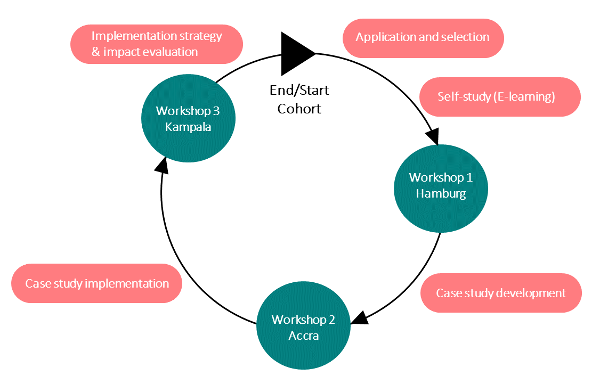
Fig. 1 FOR-GHP Training Structure
For a successful completion of the course, the participants are required to:
|
1. Complete 7 eLearning modules - these will be graded as part of the selection procedure (see below) |
01st Dec 2026 – 01st Jan 2027 |
|
2. Participate in the first workshop in Hamburg, Germany |
12th – 17th Apr 2027 |
|
3. Develop a case study ready for piloting during the first In-between workshops phase |
In-between workshops - phase 1 |
|
4. Participate in the second workshop in Accra, Ghana with pilot testing of self-developed case studies |
11th – 15th Oct 2027 |
|
5. Implement teaching case study at their home institutes |
In-between workshops - phase 2 |
|
6. Participate in the third workshop in Kampala, Uganda and take part in Sustainability Strengthening Initiative (SSI) |
03rd – 07th Jul 2028 |
After successful completion of the programme, the fellows will be awarded a certificate and granted 10 European credit transfer system (ECTS) points from the University of Basel for 300 hours SITs.
Eligibility and selection criteria:
- The FOR-GHP programme aims to strengthen public health structures across the region of sub-Saharan Africa. We are therefore looking for applicants with an origin and employement in this region.
- Professional experience of at least two years in either the public health or biomedical sector, preferably with engagement in the management, prevention and control of infectious diseases.
- A degree or proficiency in at least one of the following fields:
- Public Health
- Medicine
- Epidemiology
- Microbiology
- Biology
- allied health sciences disciplines.
- An endorsement document of the current employer confirming that the fellows are allowed to attend the fellowship alongside their work. This endorsement should include an assurance that the FOR-GHP fellow will be released from work for the three workshops and that they are supported in implementing their teaching case studies at the institute for training purposes. Please use the provided template.
- A letter of recommendation from at least one current (not older than three years) and contactable references with their contact information (email and phone).
- Advanced proficiency in English is essential for course participation and learning success. Accepted proofs of language proficiency are: TOEFL Paper 550, TOEFL Computer 213, TOEFL Internet 79–80, IELTS 6.0, native speaker, or completed higher education in English (with written proof).
- Elements of the programme will take place virtually, therefore the availability of a computer with a stable internet connection and functioning audio and microphone is required. Participation from a mobile phone or tablet is not permitted. If necessary, we expect participants to invest in purchasing additional air time to participate in the virtual activities
Selection procedure:
As spaces are limited, a three-stage selection procedure will be applied:
- The programme steering board will select the applicants to be admitted access to the first seven eLearning modules in December 2026.
- Based on the performance of a pre-qualification test concerning the seven eLearning modules, a brief essay, and additional criteria, a selection of applicants will be invited to participate in one-to-one selection interviews in English (via Zoom). Interviews will take place in January 2027.
- A final selection of the fellows will be made based on these interviews. A signed learning contract is required to complete the admission to the fellowship.
All gender identities are strongly encouraged to apply.
It is recommended to get a visa appointment at the German embassy for the first workshop already in December 2026 irrespective of knowing the fellowship application outcome, as the visa application can take a long time!
We now welcome your applications!
In order to apply for participation in the programme, please submit the completed online application form along with the required documents, as mentioned above - including a motivation letter (PDF, in English).
Open the online application form here to apply until the 21st October 2026, midnight CET.
Only electronic applications will be accepted. Please do not send hardcopy applications by mail or email. Incomplete applications will NOT be considered.
Funding of the fellowship
There are no tuition fees.
The fellowship budget covers economy-class flights, visa fees and accommodation to the three workshops. Daily meals are provided; and no daily allowances (per diems) will be paid.
Application now open!
Apply until the 21st October 2026
FOR-GHP is supported by:


Contact us
FOR-GHP
c/o BNITM
Bernhard-Nocht-Str. 74
20359 Hamburg
Germany
Tel: +49(0)40 285380 -243
email: forghp@bnitm.de